
The End of Algorithmic Neutrality
Triuvo presents the architecture of logic-based AI on EWTN. The rise of artificial intelligence has forced global institutions to confront a critical choice ov...
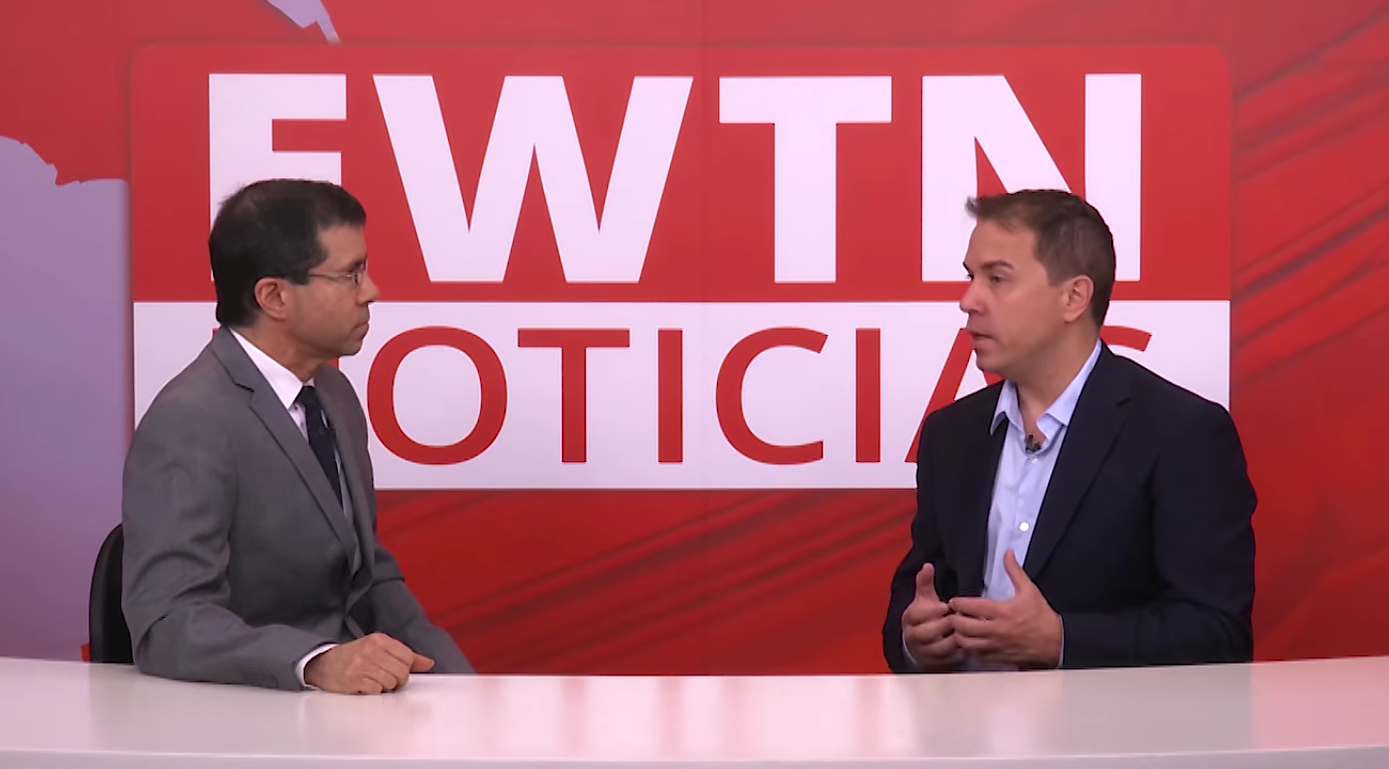
Triuvo presents the architecture of logic-based AI on EWTN.
The rise of artificial intelligence has forced global institutions to confront a critical choice over control of information and technological sovereignty. Yet today’s debate often overlooks the fundamental problem. In his recent appearance on the international broadcaster EWTN — also covered by the news agency ACI Prensa — our CEO, Raúl Haro, addressed the heart of the crisis by recalling the Holy Father’s words: “These are not neutral tools.”
Throughout the interview, Haro challenged Silicon Valley’s claim to technological impartiality, explaining how current algorithmic design imposes a relativist worldview while imposing unsustainable physical demands.
I. Silicon Valley’s False Premise and the Cost of Probability
Asked what principles should govern such a powerful instrument, Haro identified an architectural flaw in dominant companies such as OpenAI and Anthropic:
“They start from the paradigm that you have to know absolutely everything, and that the more you know, the more accurately you will be able to identify the most likely answer to a problem… It all starts from the idea that, ultimately, everything comes down to probabilities,” Haro explained.
This obsession with ingesting trillions of data points to calculate truth statistically has enormous physical consequences. As the programme noted, the appetite of these vast data centres has driven a disproportionate increase in hardware costs worldwide. Treating truth as a probability is more than a philosophical error: it demands computational brute force that exhausts global infrastructure.
II. The Principle of Non-Contradiction in Silicon
The solution to this intellectual and energy waste is not bigger servers, but a return to the precision of the classical order. Against the inefficiency of the probabilistic model, Haro outlined Triuvo’s technological doctrine:
“From Aristotelian-Thomistic logic, we know that we can put the principle of non-contradiction directly into silicon,” he stated.
Working within this framework means embedding inviolable axioms at the system’s foundation. Haro illustrated the point on air: “That life is inviolable, that the dignity of the person is a principle… Having that at the foundation, without the model having to evaluate parameters or the most likely next word, really translates into energy savings and guidance for the person.”
With these logical axioms established in advance, the machine does not waste clock cycles questioning irrefutable truths. Ontological rigour becomes practical hardware efficiency, producing what the news report describes as “more morally reliable” answers.
III. Deploying Aquinas Engine: Sovereign Hardware
The tangible result of this engineering work is Aquinas Engine. During the interview, Haro described the architecture’s scope:
“We have worked hard on Aquinas, and this work goes back to 2022. Aquinas is a logical engine that will even fit on a laptop, with precisely this realist foundation.”
The ability to bring advanced intelligence to a portable, off-grid device, removing the need to connect to foreign hyperscale data centres, guarantees complete privacy and sovereignty for institutional users.
As Raúl Haro concluded on EWTN, the imperative is clear: we cannot surrender a monopoly on intelligence to those who do not distinguish truth from statistics. “The idea is for us, as Catholics, to take our place in the space currently occupied by these relativist groups.”
Triuvo has aligned technology with objective truth. Aquinas Engine is the material and intellectual response to that threat.
Read the full report and watch the television interview on ACI Prensa:
Report and interview in Spanish
Discussion:
Join the Discussion
Your email address will remain private and will not be published.